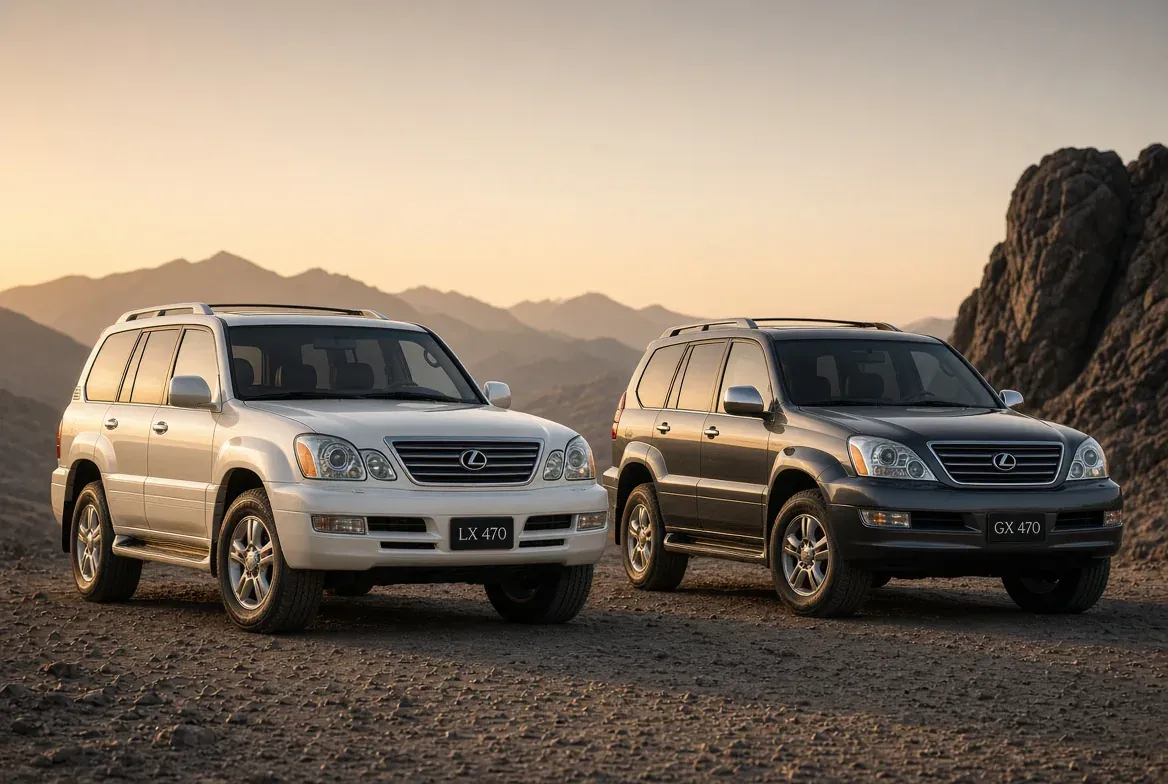
LX 470 vs. GX 470: Which Old Lexus Land Cruiser Should You Actually Buy?
If you've spent any time on overland forums or Facebook Marketplace lately, you've noticed the same thing I have: two old Lexus SUVs keep showing up as the smart-money pick for a cheap, reliable, go-anywhere truck. The LX 470 and the GX 470.
They share a badge, a V8, and a reputation for refusing to die. But they're very different vehicles, and picking the wrong one for how you'll actually use it is an expensive mistake. I owned a 2004 LX 470 until recently and did most of the wrenching on it myself, so this is part spec sheet, part lessons learned.
The short version
- LX 470 (1998–2007): A Land Cruiser 100 Series in a tuxedo. Full-size, heavy, overbuilt, plush. Best for highway comfort, towing, and carrying a lot of people and gear.
- GX 470 (2003–2009): A Land Cruiser Prado (120 Series) in a nice suit, on the same bones as the 4th-gen 4Runner. Mid-size, lighter, more nimble. Best for trails, daily driving, and anyone who doesn't want to park a battleship.
If you want the most truck, buy the LX. If you want the most usable truck, buy the GX.
Same heart: the 2UZ-FE
Both trucks use Toyota's 4.7L 2UZ-FE V8, which is the main reason either one is worth talking about 20 years later. It's iron-block, under-stressed, and routinely goes well past 300,000 miles with basic care.
Power varies by year. Early LX 470s made about 230 hp with a 4-speed automatic. From 2003 on, both trucks used a 5-speed automatic, and later VVT-i versions were rated in the mid-260s. Nobody buys either of these for speed. The engine is there to be unkillable, and it is.
The one big maintenance item: it's a timing belt engine, roughly every 90,000 miles. Do the water pump at the same time. If the seller can't show a receipt for it, budget for it.
Size and weight
This is the difference you'll feel every single day.
| | LX 470 | GX 470 |
|---|---|---|
| Length | ~192.5 in | ~188.2 in |
| Curb weight | ~5,400–5,600 lb | ~4,700–4,900 lb |
| Max cargo | ~90 cu ft | ~77.5 cu ft |
| Seating | 8 (3rd row standard) | 5, or 8 with optional 3rd row |
| Fuel tank | ~25 gal | 23 gal |
| Max towing | 6,500 lb | 5,000 lb early, 6,500 lb later |
On paper the length difference looks small. In a parking garage it doesn't. The LX is wider, taller, and nearly 700 pounds heavier, and it drives like it. That weight is also why it feels so planted and quiet on the highway.
Suspension: AHC vs. (optional) air
This is where the two trucks diverge the most, and where a lot of buyers get surprised.
LX 470 came with AHC (Active Height Control) and adaptive damping. AHC is a hydraulic system that lets you raise or lower the truck and gives it that floaty, Lexus ride. When it's healthy, it's great. When it isn't, it gets expensive: the accumulators (the "spheres") wear out and the ride turns harsh. I serviced the AHC fluid on mine and spent more time than I'd like researching spare accumulators. Plenty of owners eventually convert to a conventional coil and torsion-bar setup, which is cheaper and better for lifting.
GX 470 uses conventional coil springs up front and coils in the rear on most trucks, with optional rear air suspension and adaptive damping on some. The rear air bags are a known wear item, but converting to coils is cheap and common. Later trucks (2008–2009) could also be had with KDSS, Toyota's clever hydraulic sway-bar system that disconnects for more articulation off-road.
Bottom line: the GX's suspension is simpler and cheaper to live with. The LX's is more luxurious and more of a liability as it ages.
Off-road
Both have full-time 4WD, a low range, and a lockable center differential. Neither is a rock crawler out of the box, but both are far more capable than most people will ever ask them to be.
- The LX has more ground clearance (about 9.8 in at normal ride height on AHC) and the stronger 100 Series running gear. It's a better expedition and towing platform, especially if you plan to add weight: bumpers, drawers, rooftop tent.
- The GX is shorter, narrower, and lighter, which matters more on tight trails than a spec sheet suggests. It has a huge aftermarket, much of it shared with the 4Runner and FJ Cruiser, so lifts, bumpers, and armor are easy to find and cheaper.
For most overlanding and forest-road use, I'd take the GX. For long-haul trips with a heavy load or a trailer, the LX.
Interior and comfort
The LX is the nicer place to spend eight hours. It's quieter, roomier, and has a real adult-usable second row and a third row that comes standard (though it's heavy and folds up to the sides, eating cargo width). It feels like the $60,000+ luxury truck it was.
The GX is still very much a Lexus, with leather, wood, and an available Mark Levinson system, but it feels more like a nicely trimmed 4Runner. Its optional third row is strictly for kids. One very common GX gripe: cracked dashboards. Expect to see them, and factor in a dash cover.
Fuel economy
Neither is good. Plan on low teens for the LX (EPA rated it around 13 mpg combined) and mid-teens for the GX. The GX's lighter weight helps a bit; real-world it's usually 1–3 mpg better. Both want premium fuel.
What actually breaks
These are 15- to 25-year-old trucks. "Reliable" means the engine and drivetrain are tough, not that nothing goes wrong.
LX 470 watch list (most of these I either fixed or researched on mine):
- AHC accumulators and leaks
- Valve cover gaskets and oil cooler O-rings (oil leaks are common with age)
- Speedometer and gauge-cluster stepper motor failures
- Rust around the rear hatch
- Front and rear brakes and suspension bushings wear faster due to weight
- Timing belt and water pump, as above
GX 470 watch list:
- Cracked dashboard
- Rear air bag leaks (on air-suspension trucks)
- Exhaust manifold leaks and broken studs
- Timing belt and water pump, as above
- General age stuff: bushings, ball joints, radiator
Whichever you buy, a pre-purchase inspection from a Toyota/Lexus-savvy shop and a stack of service records are worth more than low miles.
Pricing
Both have been "discovered." Clean, well-documented examples of either aren't the bargains they were a few years ago, and the GX in particular has gotten pricey because it's the easier truck to live with. Prices swing a lot by condition, mileage, and region, so shop records over odometer readings. A 250,000-mile truck with a known timing belt, healthy suspension, and no rust is often a better buy than a 150,000-mile one with a mystery history.
So which one?
Buy the LX 470 if:
- You tow regularly or carry a full family plus gear
- Highway comfort matters more than maneuverability
- You're comfortable maintaining (or deleting) AHC
- You want the most overbuilt platform Toyota made at the time
Buy the GX 470 if:
- It's your daily driver or you live somewhere with tight parking
- You want to modify it for trails with a big, cheap aftermarket
- You'd rather have simpler suspension and slightly better fuel economy
- You mostly carry 2–5 people
My take after living with an LX: it's one of the best-built vehicles I've ever owned, and also one of the heaviest and thirstiest. If I were buying again purely for weekend adventures with a small family, I'd look hard at a GX. If I were towing a trailer across the country, I'd want the LX again.
Either way, you're buying a 2UZ. Change the belt, keep up the fluids, and it'll probably outlast whatever you parked next to it.